1. Introduction: The Evolution of Data Analysis #
In recent years, data analysis approaches have undergone a notable transformation. Businesses now have access to significant amounts of customer data, often reaching terabytes in size. Similarly, research organizations can explore expansive archives and survey data across various subjects. This growing availability of substantial data has paved the way for an entire industry focused on extracting valuable insights [1].
Data analysts face several challenges: consolidating fragmented data sources, cleaning and preparing the data, applying advanced analytical techniques, and compiling the results into compelling reports for stakeholders. We propose streamlining the reporting process using R and Knitr — a package for integrating code, outputs, and explanatory text into dynamic documents.
2. Knitr: A Tool for Dynamic Report Generation #

Knitr is an R package that “provides a general-purpose tool for dynamic report generation in R using Literate Programming techniques” [2]. Literate programming, introduced by Donald Knuth, treats programming code as a form of literature comprehensible to humans and computers. It involves seamlessly integrating source code and documentation. With Knitr, users can extract or execute the source code to obtain compiled results.
The design of the Knitr package is sufficiently flexible to handle various text documents. It comprises three essential components: a source parser, a code evaluator, and an output renderer. The parser processes the source document, identifying code chunks and inline code. The evaluator executes the code and produces results, while the renderer formats the computed results appropriately. These formatted results are then combined with the original documentation [3].
Practical Applications and Benefits #
Here are some examples of how the Knitr package can be used [4–6]:
- Reproducible reports that seamlessly integrate text, code, and output within a unified document. This ensures that all essential information is included and updates in response to code or data modifications are seamless — beneficial for sharing analysis results with stakeholders.
- Interactive documents that allow readers to modify the code and see the results in real time.
- Multi-language documents combining R with Python or SQL in R Markdown. Useful for leveraging the strengths of different languages in a single document.
- Presentations for demonstrating concepts and findings.
Overall, Knitr is a versatile tool that can be used in data analysis, research, and reporting workflows to ensure transparency, reproducibility, and effective communication of results.
The Knitr Workflow #
The Knitr-based workflow typically consists of three steps:
- Write the source document using a markup language like Markdown or LaTeX, which includes text, code chunks, and output placeholders.
- Process the source document with the Knitr engine, which executes the code chunks and includes the results.
- Convert the processed document into the desired output format (PDF, HTML, Word) using a tool like Pandoc.
3. Markup Language Options: Markdown vs. LaTeX #
While R Markdown and LaTeX are both used to create reproducible documents in R, they have distinct characteristics.
Markdown is a lightweight markup language that allows formatting plain text documents using simple, human-readable syntax. It is designed to be easy to write and read and can be converted into various formats like HTML and PDF. Markdown is commonly used for documentation, blog posts, README files, and other text-based content.
LaTeX is a typesetting system often used to create complex documents, especially those requiring mathematical or technical notation. It’s based on the TeX typesetting system and allows precise control over document layout, typography, and formatting. LaTeX is widely used in academia.
Considering LaTeX’s ability to produce visually precise PDF documents, the robustness of the tidyverse R packages for creating customized charts, and the potential of Sweave (an extension enabling seamless integration of R code within LaTeX documents), the choice of LaTeX for generating comprehensive PDF reports becomes evident.
4. System Architecture and Implementation #
A representation of the proposed system is shown in Figure 1. It allows the user to create reproducible research documents by combining R code and text, then converting them to a PDF file.
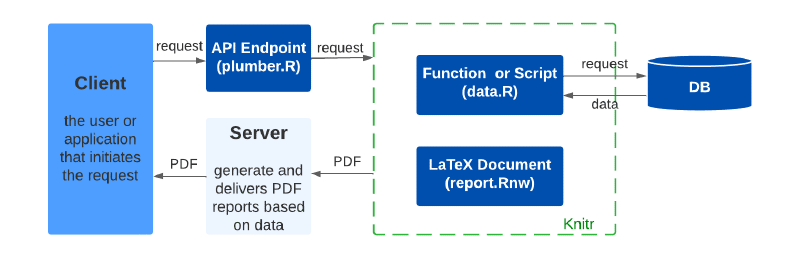
The graph has several nodes, each representing a different component:
- client — the user or application that initiates the request
- server — the backend system that handles the request and stores the data
- API Endpoint — the interface the client uses to access server functionality
- function or Script — the code that runs on the server to perform a specific task
- knitr — a tool used to convert LaTeX documents into PDF
- LaTeX Document — a document that includes both text and R code
- PDF — the final portable document format output
The flow between these components:
- The client sends a request to the API endpoint.
- The API endpoint routes the request to the appropriate function or script.
- The function or script runs on the server and returns data to Knitr.
- The R Markdown or LaTeX document is processed by Knitr, producing a PDF file.
- The PDF file is sent back to the server.
- The server delivers the PDF to the client.
This proposed service leverages the power of R, Knitr, and LaTeX to offer a streamlined approach to generating comprehensive statistical PDF reports.
5. Considerations and Future Directions #
It’s important to note that while this architecture presents a robust solution, its successful implementation heavily relies on the organization’s existing infrastructure, data management practices, and the expertise of its technical team. Effective integration, security measures, and ongoing maintenance are crucial factors to consider.
Furthermore, as the volume and complexity of data continue to grow exponentially, this system may require continuous enhancements and scalability measures. Embracing emerging technologies — such as cloud computing and advanced data visualization — could further augment the system’s capabilities and provide a competitive edge.
Ultimately, by combining the strengths of data analysis, reproducible research, and cutting-edge reporting tools, this service has the potential to revolutionize how organizations derive value from their data assets, fostering a culture of data-driven decision-making and driving innovation across various sectors.
References #
- Kabacoff, Robert. 2015. R in Action: Data Analysis and Graphics with R. Shelter Island, NY: Manning Publications.
- Xie, Y. (2023). Knitr: A General-Purpose Package for Dynamic Report Generation in R. https://cran.r-project.org/web/packages/knitr/knitr.pdf
- Xie, Y. (2015). Dynamic Documents with R and Knitr (2nd ed.). Chapman and Hall/CRC. https://doi.org/10.1201/b15166
- Xie Y (2014). “Knitr: A Comprehensive Tool for Reproducible Research in R.” In Stodden V, Leisch F, Peng RD (eds.), Implementing Reproducible Computational Research. Chapman and Hall/CRC.
- Baumer, B., Cetinkaya-Rundel, M., Bray, A., Loi, L., & Horton, N. J. (2014). R Markdown: Integrating A Reproducible Analysis Tool into Introductory Statistics. Technology Innovations in Statistics Education, 8(1). http://dx.doi.org/10.5070/T581020118
- Gandrud, C. (2015). Reproducible Research with R and Studio (2nd ed.). Chapman and Hall/CRC. https://doi.org/10.1201/9781315382548